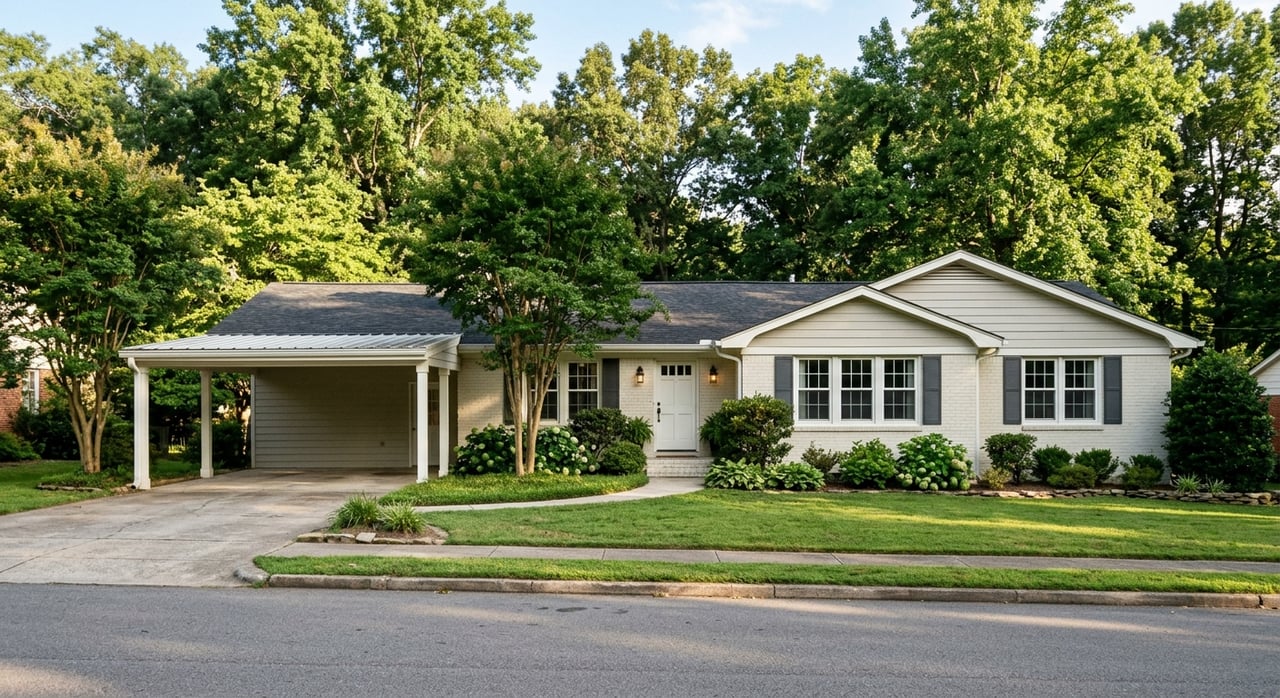
Trying to choose between Chapel Hill and Durham? You are not alone. Many Triangle buyers start in one market and quickly realize these two cities offer very different price points, housing styles, and daily routines. If you are weighing where your budget, commute, and lifestyle will fit best, this side-by-side guide will help you compare the tradeoffs clearly. Let’s dive in.
Price Differences Matter Fast
For most buyers, the first big difference is cost. In Redfin’s March 2026 snapshot, Chapel Hill’s median sale price was $503,000, while Durham’s was $425,000. That is a gap of about $78,000, or roughly 18%.
The price spread also shows up in value and monthly ownership costs. Census estimates put median owner-occupied home value at $613,700 in Chapel Hill and $392,800 in Durham. Median monthly owner costs with a mortgage were $2,912 in Chapel Hill versus $1,831 in Durham.
That means your decision is not just about the list price. It is also about how comfortable you want your monthly payment to feel after closing. For many move-up buyers and relocating professionals, that difference can shape everything from home size to savings goals.
What You Get for the Money
In simple terms, Durham usually buys more house for the dollar. Chapel Hill tends to ask buyers to pay a premium for a smaller, more concentrated market with a distinct local identity.
That does not automatically make one better than the other. It means your priorities matter. If you care most about stretching your budget, Durham may give you more flexibility. If you are focused on Chapel Hill’s location and feel, you may decide the premium is worth it.
Market Pace and Competition
Both markets are active, but they do not move at exactly the same speed. In March 2026, Chapel Hill homes sold after about 61 days on market, while Durham homes sold after about 45 days. Each market averaged roughly 2 offers per home.
For buyers, that suggests Durham may move a bit faster overall, even though both markets can still involve competition. A shorter timeline means you may need to make decisions quickly when the right Durham home appears. In Chapel Hill, you may see a little more time on market, but you are still shopping in a higher-cost environment.
Housing Styles in Chapel Hill
Chapel Hill has a strong historic and university-centered identity, and that shows up in its housing stock. The town identifies three local historic districts: Franklin-Rosemary, Cameron-McCauley, and Gimghoul. It also recognizes five National Register historic districts.
If you like homes with character, Chapel Hill may appeal to you. Town historic-district documentation describes Colonial Revival as the most common historic style, with Dutch Colonial Revival also present. You will often find one- and two-story side-gabled homes and other early- to mid-20th-century forms.
That character can come with extra planning. In Chapel Hill’s local historic districts, exterior changes require a Certificate of Appropriateness. If you are shopping for an older home, it is smart to understand how those review rules may affect future updates.
Housing Styles in Durham
Durham offers a broader architectural mix and a more urban range of housing options. The city lists eight local historic districts, and preservation documents point to common styles such as bungalow, Craftsman, Colonial Revival, Foursquare, and English Cottage.
You also see more variation in how homes and buildings have been reused over time. Preservation Durham notes the city’s history of adaptive reuse, including former tobacco warehouses and factories converted into other uses. For buyers, that translates into a wider menu that can include bungalow neighborhoods, loft-style conversions, and newer infill homes within the same market.
Like Chapel Hill, Durham regulates exterior changes in local historic districts and landmarks through a review process. If historic character is part of your home search, both cities reward buyers who do a little homework before making an offer.
Daily Life Feels Different
Chapel Hill and Durham are close together, but day-to-day living can feel different. Chapel Hill is the more compact, university-centered option. The town highlights its connection to UNC-Chapel Hill, along with arts, culture, community events, historic homes, and modern apartments.
Franklin Street plays a big role in that experience. The Chapel Hill visitors bureau says historic Franklin Street has more than 200 restaurants, bars, retail shops, and service businesses, and 140 West Franklin Plaza serves as a gathering space for events. If you want a routine centered around a compact downtown and campus energy, Chapel Hill may feel like a natural fit.
Durham offers a broader city scale. With a population of 301,870 compared with 64,028 in Chapel Hill, Durham is the larger market by far. The city highlights attractions such as DPAC, Durham Bulls Athletic Park, the Nasher Museum of Art, and nearly 100 city-owned parks and recreation facilities.
Downtown Durham also has the Bullpen social district, which operates from 11 a.m. to 10 p.m. every day. Taken together, Durham gives you a wider spread of amenities and neighborhood identities. If you want more variety across a larger city, Durham may offer more options.
Commute and Transit Comparison
Commute patterns matter, especially if you are relocating or balancing work in multiple parts of the Triangle. Census estimates show mean travel time to work at 19.5 minutes in Chapel Hill and 22.3 minutes in Durham. That is not a rule for every household, but it does suggest Chapel Hill residents have slightly shorter average work trips.
Transit is a strength in both places. Chapel Hill Transit fixed-route service is fare-free. GoDurham says its fares will remain fare-free through June 2026.
Regional connections also help tie the markets together. GoTriangle’s Route 700 runs between Durham Station and the Regional Transit Center every 30 minutes, while Routes 800 and 805 run between Chapel Hill and the RTC every 30 minutes. GoTriangle also operates an RDU Shuttle from the RTC and a Route 100 airport connection after 6:30 p.m. and on Sundays.
If you want a simpler, more compact routine, Chapel Hill may be appealing. If you want broader mobility across Durham, Southpoint, and the RTC corridor, Durham may feel more flexible.
Rent and Ownership Tell Different Stories
One of the more interesting comparisons is the gap between rent and ownership costs. Census estimates show median gross rent at $1,613 in Chapel Hill and $1,508 in Durham. That is only about $105 per month.
Ownership is a different story. The owner-occupied home-value gap between the two cities is much larger, and so is the monthly owner-cost gap. For buyers deciding whether to keep renting a bit longer or move into ownership now, this comparison can help frame the decision more clearly.
How to Decide Which Fits You
A Chapel Hill home search often comes down to location, historic character, and a university-town setting. Durham often comes down to budget flexibility, broader housing variety, and access to a larger city experience. Neither choice is right for everyone.
You may lean toward Chapel Hill if you want:
- A smaller, more concentrated market
- A strong university-centered identity
- More historic character in certain in-town areas
- Slightly shorter average commute times
- A setting you are comfortable paying more to access
You may lean toward Durham if you want:
- A lower purchase price point
- Lower typical monthly owner costs
- More housing variety across styles and settings
- A broader entertainment and amenity base
- A larger city with more neighborhood options
A Smart Buyer Strategy
If you are torn between the two, the best next step is usually to compare them through your real budget and routine, not just your wish list. A home that looks ideal online can feel very different once you factor in monthly payment, commute patterns, home style, and how you want your week to flow.
That is especially true in the Triangle, where buyers often cross city lines while trying to find the right fit. Looking at Chapel Hill and Durham side by side can help you avoid narrowing your search too early.
When you are ready to compare neighborhoods, price points, and homes that match your goals, Charles Christiansen can help you build a focused plan for your move.
FAQs
What is the price difference between Chapel Hill and Durham for home buyers?
- In Redfin’s March 2026 snapshot, Chapel Hill’s median sale price was $503,000 and Durham’s was $425,000, a difference of about $78,000.
Is Chapel Hill or Durham more affordable for monthly ownership costs?
- Census estimates show median monthly owner costs with a mortgage at $2,912 in Chapel Hill and $1,831 in Durham, so Durham is the lower-cost option in this comparison.
Does Durham offer more housing variety than Chapel Hill?
- Yes. Based on the research, Durham generally offers a wider range of housing types, including bungalow neighborhoods, loft-style conversions, historic districts, and newer infill.
Are homes in Chapel Hill more historic in character?
- Chapel Hill has a strong historic identity, with local historic districts and common styles such as Colonial Revival and Dutch Colonial Revival, which can appeal to buyers looking for older homes with character.
Which city has the shorter average commute, Chapel Hill or Durham?
- Census estimates show Chapel Hill with a mean travel time to work of 19.5 minutes compared with 22.3 minutes in Durham.
Can you live in Chapel Hill or Durham and still use transit around the Triangle?
- Yes. Both Chapel Hill Transit and GoDurham currently offer fare-free service, and GoTriangle connects Chapel Hill, Durham, the Regional Transit Center, and airport-related routes.